
1H CRT
Candle Range Theory on the 1H timeframe: hour sweeps prior 1H extreme, closes back in body, next move targets opposite liquidity. Recalibrated against true-CRT hit rate. The GOLDEN tier (PDF Soup-Room filter) layers a key-level proximity gate on top — hr=9 SHORT lifts to 78%, hr=2 SHORT to 65%.
updated 2026-04-29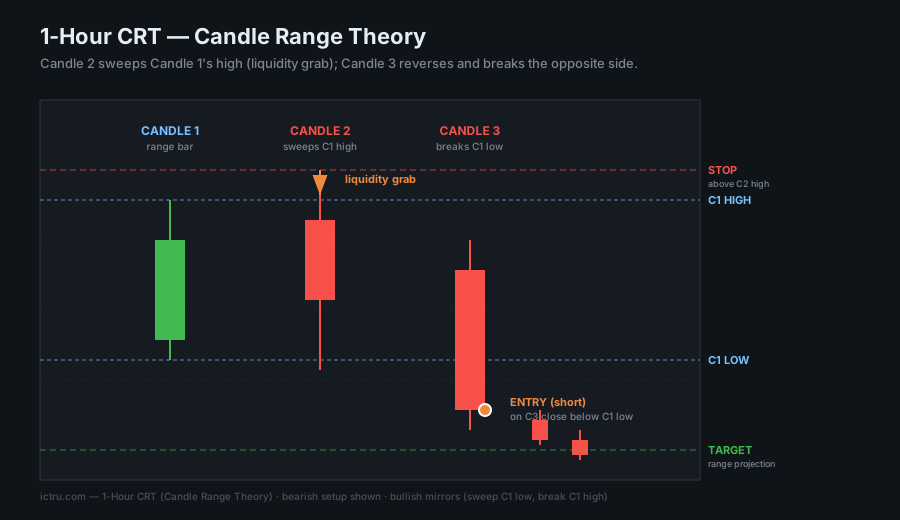
The setup
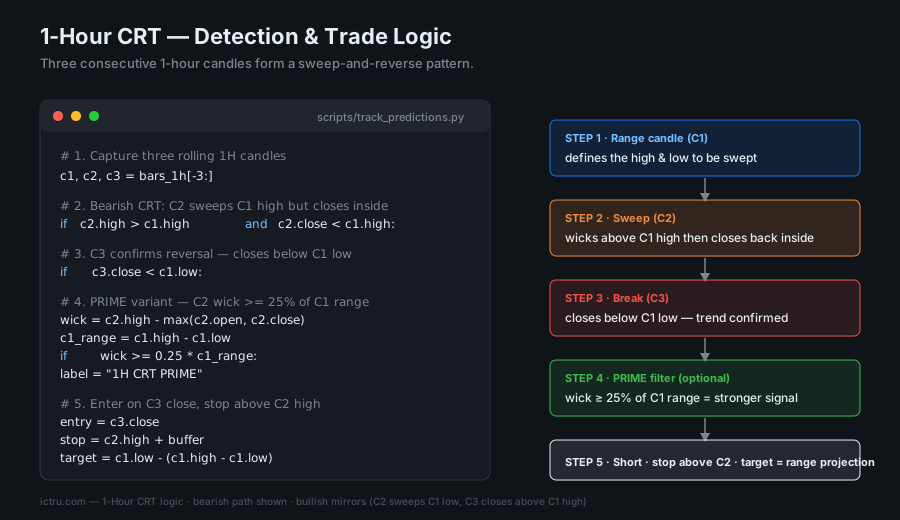
Candle Range Theory (CRT) on the 1H: a 1H candle sweeps the prior 1H high or low, then closes back inside the prior candle’s body. The read: the sweep was a liquidity raid; the next move targets the opposite extreme.
Line ships on our chart HUD as 1H CRT LONG / 1H CRT SHORT (or 1H CRT PRIME on the top hours).
Entry rules
- Trigger: 1H candle closes; wick beyond prior 1H H or L; close back inside prior body
- Direction: opposite the wick (fade the raid)
- Target: opposite prior-1H extreme
- Stop (implicit): sweep-wick extreme
- TTL: 180 minutes
Viable hours (n ≥ 30, hit rate ≥ 52%):
| Hour ET | LONG | SHORT | Tier |
|---|---|---|---|
| 00 | 54% | — | 2 |
| 01 | — | 55% | 2 |
| 02 | 52% | 53% | 2 |
| 06 | 54% | — | 2 |
| 07 | 64% | 55% | 1 LONG |
| 08 | 54% | — | 2 |
| 09 | 62% | 64% | 1 both |
| 18 | — | 82% | 1 SHORT |
All other hours: both directions below viability. Does not fire.
Depth adjustment (sweep-wick depth past prior extreme):
- LONG: <3pt −5% · 10–20pt +3% (peak hit rate)
- SHORT: <3pt −5% · ≥20pt +6% (deep sweeps 20–40pt hit 55%, 40pt+ hit 66%)
The recalibration story
This model used to fire 1H CRT PRIME 91% at hr=6–8 AM, which felt great. Then we built the CRT-reversal backtest and measured the true-CRT hit rate (price touches opposite extreme before sweep-wick stop, within 180 min). The gap was brutal:
| Hour / Dir | Old PM prob | Actual true-CRT | Δ |
|---|---|---|---|
| 04 LONG | 81% | 27% | −54pt 🚨 |
| 06 LONG | 91% “PRIME” | 54% | −37pt |
| 08 LONG | 83% | 54% | −29pt |
| 07 LONG | 91% “PRIME” | 64% | −27pt |
| 18 SHORT | not fired | 82% | missing entirely |
| 09 SHORT | 83% | 64% | −19pt |
The old probabilities came from “close-same-direction within 120m” drift — which is not the question PM’s target field asks. We fixed the metric and rebuilt the table against n=5,160 signals over 5 years.
PRIME combo
isPrime = (hr==18 && SHORT) || (hr==09) || (hr==07 && LONG)
Only these combos earn the PRIME badge. 18 SHORT is the strongest single combo in the dataset.
2026 regime watch
- hr=07 LONG dropped 64% → 29% in 2026 (n=7 — small, but worth watching)
- hr=09 SHORT stable at 55% in 2026 ✓
- hr=18 SHORT still 100% hit (n=2) ✓
If hr=07 LONG’s 2026 slump persists past n=30 we’ll drop it from PRIME.
Cross-contract stability
| Symbol | n | Hit rate | vs MNQ |
|---|---|---|---|
| MNQ | 3132 | 81.6% | (base) |
| MES | 3125 | 80.5% | -1.0 |
| MYM | 3019 | 81.8% | +0.3 |
| MCL | 2890 | 76.0% | -5.6 |
| MGC | 3070 | 73.6% | -8.0 |
| SI | 3190 | 73.7% | -7.9 |
| MBT | 2431 | 77.1% | -4.5 |
Why Tier 2 overall (Tier 1 for PRIME combos)
- Many hours below viability — gated hard.
- PRIME combos (07 LONG, 09 both, 18 SHORT) earn Tier 1 treatment individually.
- Rest are solid but not flagship. The model as a whole is Tier 2.
GOLDEN tier — key-level confluence (Soup-Room CRT)
A community framework called “Soup Room CRT” (PDF distillation of an ICT-style entry model) argues that a CRT sweep that occurs while testing a same-direction key level is qualitatively different from one in open space. We tested the claim against our 5,169-signal MNQ dataset.
Method
For every CRT signal, compute the distance from the swept level (the prior-1H extreme that got raided) to the nearest same-direction named level:
- SHORT: nearest of PDH, PWH
- LONG: nearest of PDL, PWL
Bucket signals by distance and compare hit rate.
Headline result
The PDF’s filter does not generalize across all 24 hours — pooled lift is ~3pp, noise. But within the PDF’s named hours, it lights up:
| Window | Direction | All sigs | <25pt gated | Δ vs ≥25pt |
|---|---|---|---|---|
| LND Twilight (hr 2–5) | SHORT | 559 / 45.4% | 136 / 51.5% | +8.0pp |
| 5AM CR (hr=5) | SHORT | 128 / 40.6% | 27 / 51.9% | +14.2pp |
| 9AM CR (hr=9) | SHORT | 134 / 64.2% | 50 / 78.0% | +19.3pp |
| 9AM CR (hr=9) | LONG | 66 / 62.1% | small-n | — |
| PRIME hours (7, 9, 18) | both | 476 / 64.5% | 66 / 71.1% at <25pt | +6.6pp |
Per-hour, gated to <25pt
The bucket cliff is sharp at 25pt — beyond that, the lift collapses:
| Bucket | n | Hit |
|---|---|---|
| <5pt | 22 | 63.6% |
| 5–10pt | 16 | 81.2% |
| 10–25pt | 57 | 77.2% |
| 25–50pt | 80 | 62.5% |
| 50–100pt | 97 | 60.8% |
| 100pt+ | 204 | 59.8% |
Below 25pt: ~75%. Above: ~62%. That’s the line.
What didn’t work
- Asia window (hr 18–21) — the PDF’s Asia model goes negative both directions (longs −10pp gated, shorts flat). The hr=18 SHORT PRIME combo we already trade is not an Asia-model sweep; it’s the daily-close hour on a different mechanism.
- hr=4 and hr=8 — both go more wrong when gated.
- PWL / PMH / PML — too few near-misses to register; PDH/PDL dominate.
- All-hours pooling — drowns the signal in 10–17 ET garbage hours we don’t trade anyway.
What ships as GOLDEN
isGolden = ((SHORT and hr in [2, 5, 9]) or (LONG and hr in [7, 9]))
        and swept_level within 25pt of [PDH, PWH] (S) or [PDL, PWL] (L)
When GOLDEN qualifies, the model’s hour-table probability gets +10pp lift, label promotes from 1H CRT / 1H CRT PRIME to 1H CRT GOLDEN, confidence flips to HIGH, and the signal is treated as Tier 1 in the consensus scorer (same regime/penalty calibration as PRIME).
Caveats
- Sample sizes for individual GOLDEN combos are modest (hr=5 SHORT n=27, hr=2 SHORT n=54). The +10 prob lift is the empirical mean of the per-hour deltas — it’s not Brier-tuned.
- Only PDH/PWH/PDL/PWL counted toward proximity. Adding 4H OB midpoints, ASIA H/L, ORB H/L, and 4H FVG edges (the PDF’s actual “key level” definition) would likely tighten the filter further. Open follow-up.
- Because gating cuts the sample roughly 5× in PRIME hours, GOLDEN fires are rare — expect ≈10–15 per year on MNQ. The PRIME tier still carries most of the trade volume.
History
- 2026-04-19 — Original ship with old probability table.
- 2026-04-23 — Full recalibration against true-CRT hit rate. Overconfidence gaps of 27–54pt closed. Missing hr=18 SHORT edge added. New PRIME combo gate.
- 2026-04-29 — GOLDEN tier added (PDF “Soup-Room CRT” key-level filter). Backtest
backtest_crt_keylevel_overlay.pyn=5,169 — gating lifts hr=9 SHORT to 78% and hr=2 SHORT to 65%. Wired into PredictionModel.cs Model 12, track_predictions.py, smc_analysis.py setup override, and TIER1 sets.